Folky, Folkie lecture at Cecil Sharp House

----------------------------------------------------------

Yesterday I gave a talk as part of a series of lectures at Cecil Sharp House called 'What the Folk?', as the artist in residence. I chose to talk about my work in terms of the insider/outsider poles that seem to define the folk world and making art that deals with folk.

I guess the definitions I am working with are:

FOLKIE: a person who defines themselves as a lover of folk music and culture. In particular they are likely to attend folk festivals and events, and have a rigourous definition of what 'folk' means to them, and what it should mean to others.

FOLKY: contemporary artwork of the kind that references folk motifs, folkore, folk tradations and costumes, but is definitely not Folk Art itself.


It was a talk to an audience richly knowledgable on folk topics but not so much on contemporary art and artists. I got asked questions like

'why do you feel the need to change traditions as part of your work'

and

'is folk art?'.


These are pretty big questions that an artist could spend a whole career trying to answer. My instinctive answers though didn't take that long, and I feel like perhaps because I am coming from an insider's perspective (as a folk practicioner) I have a bit more licence to alter certain aspects of folk traditions or imagery for the purposes of making an artistic statement. The answer to the second question would really depend on context, and in answering it I retreated to the contextual corner. As more and more artists work with folk thematically and directly in their work it seems less like a question about whether or not it is art, but why there is such a move to re-examine it in artworks.

'What the Folk?' lecture at Cecil Sharp House

----------------------------------------------------------

Saturday 16 May / Saturday 30 May
What the Folk? Lectures
1pm, £5, Free to enrolled Saturday Workshop Students


The What the Folk? Lecture series continues with EFDSS artist-in-residence Matthew Cowan on Saturday 16 May. Folky, Folkie will provide fascinating insight into his art practice, debate of folks relationship to the art world and enlightenment to the current exhibition at the house, Flash Company.

British Film Institute

----------------------------------------------------------

Last night I went to the British Film Institute on the South Bank.

Jigs & Rituals: British Folklore on Film
Mysterious, eerie, colourful and rousing – the folk customs of the British Isles are all these things and more. The films presented tonight, in part drawn from a recent donation to the BFI from the English Folk Dance and Song Society, offer a range of approaches to documenting these dances and traditions. Highlights include Oss Oss Wee Oss (1952) a beautiful and evocative documentary about a 'sexy, savage springtime rite' (made by blues song-hunter Alan Lomax), a newly restored early sound film of folk musician Sam Bennett (1926) and the 'what-the-butler-saw' type Kinoras of Cecil Sharp and George Butterworth dancing over 100 years ago and accompanied tonight by a traditional fiddle player.


The BFI were showing some films that EFDSS have recently donated to them. These included some very old restored footage of Sam Bennett of Ilmington dancing Morris jigs and playing fiddle for a girls Morris team.

There was a live fiddle player playing along to some of the dances which included footage of old staid Cecil Sharp himself dancing. Some of these had been restored to digital from Kinora cards.

The footage of Sam Bennett looked to me like a man dancing in an extremely casual way. An untrained eye might have even mistaken his dancing for a parody of a morris jig, with hankies and knees all over the place. I loved it.

Sam Bennett


Flash Company Private View

----------------------------------------------------------

Images from the Prviate View at Cecil Sharp House, 29th April 2009.
Sam Lee singing Flash Company, and the Hammersmith Morris Men performing jigs.


Exotic England: Tour By Bus

----------------------------------------------------------
The handbook of Morris Dances by Lionel Bacon is practically a bible for morris dancers, and in my time has settled numourous disputes and disagreements on style, stepping and figures.

The book lists the traditions of the dances collected by Cecil Sharp and presents them alphabetically, by the names of the places where they were recorded. The dances have come to have been known by these placenames.

I am also especially fond of the dance notation that Mr Bacon employs. It is an improvement on Cecil Sharp's and has a humour all of its own.

Here is a googlemap of these villages should anyone wish to drive through them all.


View Cotswold Morris Villages by Destination in a larger map

Click here to view the finished painting

Flash Company. A Handkerchief Show at Cecil Sharp House


A Handkerchief Show at Cecil Sharp House

Continuing a visual arts programme under the curation of artist-in-residence Matthew Cowan, the English Folk Dance and Song Society is pleased to present Flash Company, A Handkerchief Show at Cecil Sharp House.This exhibition is a group show of new work by a diverse range of contemporary artists from the UK, Portugal, Australia, New Zealand, U.S.A and Japan taking as a starting point a humble white handkerchief. Artists working in a wide range of media have been invited to take part, and all have been sent a single handkerchief with which to work. The resulting works will be hung at Cecil Sharp House, the home of the English Folk Dance and Song Society.

Looking beyond their prime role in the dancing kit of Morris dancers, handkerchiefs have a rich history in the framework of society. From high fashion to perfect manners and sexual politics, the handkerchief has played its part as an essential accessory. The show takes its name from the folk song of the same name, a jaunty tale of handkerchiefs and ruin.The finished works will be hung in Cecil Sharp House throughout May and June, and entry to the show is free.
30 April – 28 June (Tues - Sat, 10am - 6pm)

Click HERE for the full exhibition website.

Artists Participating in the show:

Lawrence Abu-Hamdan, David Beech, Mike Berners-Winters, Catherine Bertola, Bishi & Giles Pearson, Michelle Bloom, Gwen Brinton, Gail Burton, Maurice Carlin, Ele Carpenter, Billy Childish, Emma Cowan, Matthew Cowan, Michael Davies, Alec Finlay, David Foggo, Sarah Foque, Mami Fujita, Jon Garlick, Rachael Gorchov, James Johnson-Perkins, Paul Hearn/Lustrous Chemistry, Zuzana Lola Hruskova, Lee Hunter, Kathryn Johnson, Alan Kane, Maiko Kobayashi, Serena Korda, Sonya Lacey, John Lawrence, Sam Lee, Caterina Lewis, Hayley Lock, Peter Locke, Cathy Lomax, Anna Maltz, Hannah Maybank, David McKeren, Pete McPartlan, Erin O'Connor, David Owen, Hyungji Park, Michal Pashtan & Matthew Green, Clare Qualmann, Nic Rawling, Adam Rompel, Marianne Shorten, Helen Smith, Rose Smith, John Stark, Keara Stewart, Matt Stokes, Maggie Tran, Clare Undy, Graeme Walker, Clare Wilson

Private View: 29 April, 6pm
Cecil Sharp House
2 Regents Park Road
LONDON
NW1 7AY
www.efdss.org

Master Your Own Mummers Disguise!

----------------------------------------------------------


I'm running a workshop at Chalk Farm Library on making Mummer's costumes on 17th April with Debs Newbold. We are going to make complete head to foot disguises from copies of the Camden New Journal.

There will also be chocolate.

from the Love Spray Series

----------------------------------------------------------


I have finished my submission for the Flash Company exhibition. Its part of a series that I am working on, inspired by a can of LOVE SPRAY that I bought in New York a few years ago.

The Ukelele Orchestra of Great Britain

----------------------------------------------------------
The Ukelele Orchestra of Great Britain have their office next door to the room that I am working in at Cecil Sharp House. They have been very kind in letting me borrow an internet connection from them recently, and I got a chance to see them play live in Kennedy Hall last night.
They are true masters of adapting wild variations of hip tunes for their 'ukes'. Perhaps though their most endearing quality is the incongruous size of their instruments. Ukeleles look absurd in the hands of large grown men and women.

Their audience is particularly loyal and it was obvious most people there were not in their audience for the first time.

Rock and Roll.

Handkerchief Show: Flash Company

----------------------------------------------------------

I have decided that the first show that I curate at Cecil Sharp House will be a Handkerchief Show. I am still sorting out the details of what this will involve, but I am interested in approaching a wide range of artists to make work on a single blank handkerchief.

With the help of Peta in the Vaughn Williams Memorial Library, I have been researching references to handkerchiefs in folk song, and unsurprisingly, given its rich symbolism there are a lot of references. Perhaps the most well known though is the Song Flash Company, with its reference to a Yellow Handkerchief: "take this yellow handkerchief in rememberance of me..."


So there is the title for the show. Perhaps the tale of ruin and poverty caused by high living and abandon is an apt metaphor for the artists of our time. We'll see.

Making Folk [into] Art in Cecil Sharp House

----------------------------------------------------------

I like to describe my art practice as lying between the positions of an outsider (in the UK) and an insider (in the folk world). I mention this on the statement at the beginning of my website:

"Matthew Cowan’s practice is in the realm of traditional British and European customs. His works are photographs, videos, installations and performances, which play with the inherent strangeness of the continued popularity of long established folk customs in a modern world.

These works can be viewed as mock folk performances in themselves, playing with the elements of folk rituals that give people a link to the past. In particular, the English have peculiar relationship with their folk traditions that is part uneasiness about their past, and part fascination with spectacle and long established ritual.

In investigating the celebration and performance of folk traditions, a primary theme is the presence of humour and subversion of the usual social order. This comical reversal is a key to understanding the point of people’s enjoyment of folk and ritual traditions."

It is a strange feeling then to arrive to begin an artist in residence program at somewhere like the English Folk Dance and Song Society, and find that the works that I have been making in the recent past feel very different when I place them in this building. It is fairly obvious to me straight away that my position is as a contemporary artist, who works with the ideas and concepts of 'folk' traditions - rather than as a folk performer who presents his work as art. I notice this as I bring sculptures like the Four Hobby Horses of the Apocalypse and begin to hang them in my studio. They look as if they belong in this building, and that is the alarming thing to me. I have always enjoyed how out of context these objects, which look like Folk objects, appear in a contemporary art setting. When they are at the English Folk Dance and Song Society, their absurdity disappears.


I was not expecting this to happen!

----------------------------------------------------------

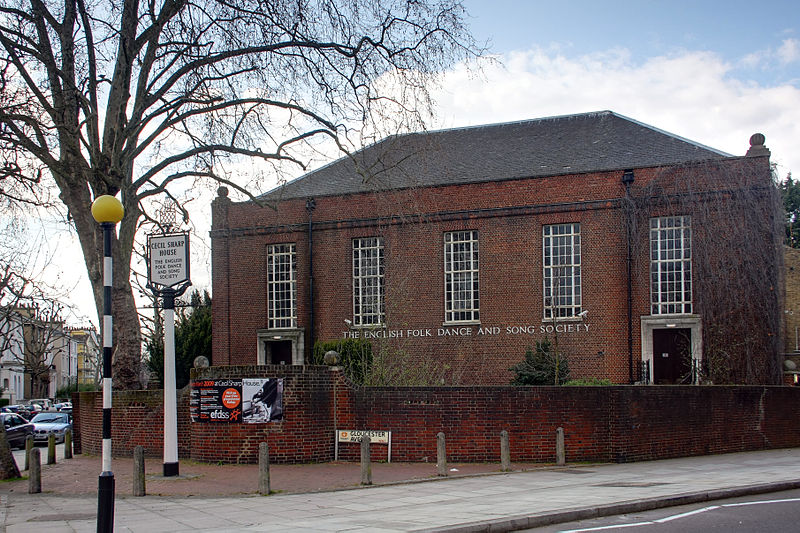
An Artist in Residence at Cecil Sharp House

This is the beginning of an archive of activity during my residency at Cecil Sharp House, the headquarters of the English Folk Dance and Song Society during 2009. I am working as artist in residence and will be working on curating and education projects as well as using the House as a base for my practice over the coming year. Hopefully I will find some space in the busy building to make some new work, and make use of the Vaughn Williams Memorial Library. I'm hoping to as expand my folk expertise too, and meet some of the wide and varied communities that use Cecil Sharp house.

Cecil Sharp House has always had an exotic air to me, and since I first arrived at the library for a research visit during a short trip from New Zealand in 1999, it has seemed like a dazzling archive of folk knowledge and material. The library still has a familiar smell to it, and is obviously overcrowded with amazing volumes of folk tunes and folklore from around the world. The building itself is from another age, an age where grand national and dare I say it political ideas of what folk culture itself was are different from what we know it to be today. Having recently returned from an arts residency project in Poland, where I saw first hand the centrally funded folk arts institutes and organisations that operate on a regional basis, I am hoping to get a better feel for how things work in England over the course of the coming months.

At this stage its almost too much to process and find a place to begin as an artist. I like to think of myself as an agent from the Antipodes sent on behalf of the Morris and Sword dancers of Aotearoa, and I will duly report back on my findings and work in these pages over throughout the year.

Matthew Cowan
January 2009